To clean dental implants, brush twice a day with a soft-bristled toothbrush, clean around and between the restoration every day, and keep professional maintenance visits on the schedule your dental team recommends.
Implants do not get cavities, but plaque around them can inflame the gums and contribute to bone loss, so consistent cleaning is essential for long-term stability and for the benefits discussed in implants to prevent bone loss.
If you want to protect your dental implants and keep gum and bone health stable, routine dental exams & cleanings are the best way to catch early problems and maintain restorations. Scottsdale Center for Implant Dentistry in Scottsdale, AZ provides gentle, personalized preventive care to help implants last and tissues stay healthy.
Use a manual or powered soft-bristled toothbrush with a low-abrasive fluoride toothpaste unless your dentist recommends a different product. Brush for about two minutes and angle the bristles toward the gumline where the implant crown or bridge meets the tissue.
Clean between the implant and nearby teeth once a day. Depending on the space and restoration, your dental team may recommend floss, implant-safe floss threaders, interdental brushes with coated wire, or a water flosser.
A water flosser can help flush food and plaque from hard-to-reach areas, especially under an implant bridge. It may not replace other tools in every case, so ask your hygienist to show you the right angle, pressure setting, and tip size for your restoration.
Implants support different types of restorations, and each design changes how you clean around it. All-on-4 implants are one full-arch option that often supports a fixed row of teeth on four implants, although the exact number and position vary by anatomy and treatment goals.
|
Implant Restoration |
Daily Cleaning Focus |
Commonly Recommended Tools |
|---|---|---|
|
Single implant crown |
Gumline and both sides of the crown |
Soft toothbrush, floss, or small interdental brush |
|
Implant-supported bridge (see how to clean implant supported bridge) |
Under the replacement teeth and around each implant |
Floss threader, bridge floss, interdental brush, or water flosser |
|
Fixed full-arch restoration |
Entire space beneath the prosthesis and each implant site |
Angled brush, threader floss, interdental brush, and water flosser |
|
Removable implant overdenture |
Denture surfaces, attachment areas, gums, and tongue |
Denture brush, soft toothbrush, and dentist-approved cleanser |
If you wear a removable overdenture, take it out as directed and clean it over a sink partly filled with water or over a folded towel. Avoid hot water, which can distort some materials, and do not use household bleach unless your dentist specifically approves a product for that appliance.
Plaque is a bacterial film that builds up around both natural teeth and implants. Early inflammation around an implant is called peri-implant mucositis and may cause redness, tenderness, swelling, or bleeding during cleaning.
If inflammation progresses and bone is lost, the condition is called peri-implantitis. Early professional care can often control these problems more effectively, while advanced bone loss can threaten implant stability and may require more complex treatment, including gum disease treatment.
Smoking or vaping, poorly controlled diabetes, a history of gum disease, difficult-to-clean restorations, and inconsistent maintenance may increase risk factors, including concerns discussed in gum disease and implants. These factors do not automatically prevent implant success, but they often justify closer monitoring and a more individualized cleaning plan.
Single implants, implant-supported bridges, and full-arch restorations are used for different patterns of missing teeth. Long-term success depends not only on stable placement, but also on a restoration shape that leaves enough access for daily plaque removal.
Digital scans, cone-beam CT imaging, and computer-guided planning help clinicians evaluate bone, nearby nerves, sinuses, and the planned tooth position. Surgical guides or robotic assistance may improve positional precision and help support a restoration design that is easier to maintain, although they do not remove surgical risk or guarantee a specific outcome.
Before treatment, ask how the proposed crown or bridge will be cleaned at home. It is also reasonable to ask whether the design can be removed professionally if repairs or deeper cleaning are ever needed.
Planning usually includes a medical and dental history, gum evaluation, bite analysis, imaging, and a discussion of anesthesia or sedation options. Some patients need gum treatment, tooth removal, or bone grafting before or during implant placement.
During surgery, the clinician places the implant in the jawbone. Healing then allows osseointegration, which is the stable bond that forms between bone and the implant surface.
The final crown, bridge, or full-arch restoration is made after the implant reaches suitable stability and the tissues heal. Timing varies based on bone quality, grafting, implant location, overall health, and whether the implant was placed immediately after extraction.
Follow your surgeon's instructions closely during early healing. Brushing, flossing, or water-flosser use may need to be modified near the surgical site for a short time.
Do not probe under the gums or start using a new device around the wound unless your treating clinician says it is appropriate. Mild swelling, soreness, bruising, or slight oozing can happen after placement and often improves within several days.
Soft-tissue healing commonly takes one to two weeks, while bone integration often takes several months and may take longer after grafting. Contact the office promptly for worsening pain or swelling, persistent bleeding, pus, fever, a bad taste, wound opening, or a restoration that feels loose.
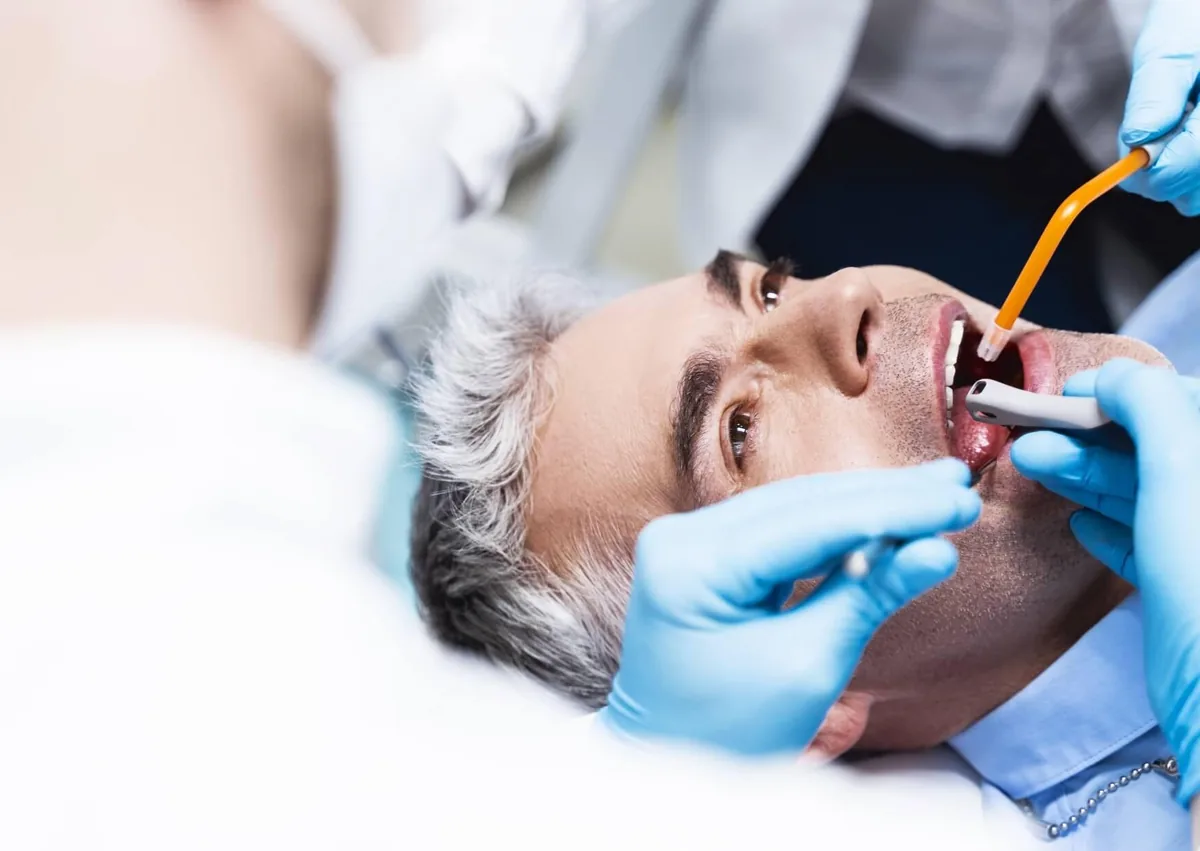
Implant maintenance visits usually include a gum exam, plaque removal, bite evaluation, and imaging when clinically indicated. Regular dental exams & cleanings help detect early inflammation and keep restorations functioning well.
Many patients are seen every three to six months, but the right interval depends on gum health, plaque control, smoking status, diabetes, prior periodontal disease, and restoration complexity. A personalized maintenance schedule is more useful than a one-size-fits-all interval.
Do not try to tighten, remove, or repair implant parts at home. Avoid metal picks, sharp objects, highly abrasive powders, and forceful cleaning that can injure the gums or scratch restoration surfaces.
Implants may be considered for one missing tooth, several missing teeth, unstable dentures, or full-mouth restoration. Good candidates generally need enough bone or a workable grafting plan, manageable medical risks, healthy or treated gum tissue, and the ability to keep the restoration clean.
Age alone is usually less important than growth status, overall health, bone condition, and healing capacity. A comprehensive implant evaluation can clarify whether a single implant, implant-supported bridge, an All-on-4 approach, a removable overdenture, or another solution best fits the clinical situation and cleaning demands.
Bring any implant records and a current medication list to the evaluation if possible. Your dental team can assess the tissues, recommend cleaning tools, and build a prevention plan that matches your restoration.
A focused maintenance visit can identify inflammation early, protect supporting bone, and keep your implants functioning long term. Call Scottsdale Center for Implant Dentistry for dental exams & cleanings in Scottsdale, AZ, with care also available for patients from North Scottsdale and Carefree; (480) 306-8510 to schedule.
No. Titanium implants and artificial crowns do not decay like natural teeth, but nearby teeth can still get cavities and the tissues around implants can become inflamed or lose bone.
A soft-bristled manual or powered toothbrush works well for many implant restorations. The best choice is one that reaches the gumline comfortably and can be used consistently without causing trauma.
Often, yes. The right technique depends on the shape of the implant crown or bridge, so use the product and method your dental team demonstrates and avoid snapping floss forcefully under the gums.
Cleaning usually involves directing an angled brush, threader floss, interdental brush, or water flosser beneath the fixed bridge and around each implant site. Because space and contours differ, a hygienist should show you the best access points and tools for your restoration.
Occasional minor irritation can happen, but repeated bleeding during gentle cleaning may signal inflammation. Arrange a dental evaluation if bleeding persists, worsens, or happens with swelling, pain, pus, a bad taste, or looseness.