For most adults, it is rarely too late to get dental implants because of age alone or because teeth have been missing for many years. The real limits are usually bone loss, active dental disease, smoking, uncontrolled medical conditions, or other factors that make surgery or healing less predictable.
Even then, treatment is often still possible with added planning, grafting, or a different implant design. The only reliable way to know is with an exam and three-dimensional imaging.
If you’re deciding whether dental implants are still an option after long-term tooth loss or bone changes, a focused evaluation can identify realistic pathways for restoring function and appearance. Scottsdale Center for Implant Dentistry in Scottsdale, AZ, helps patients weigh implant choices and practical benefits so you can understand what to expect.
After a tooth is lost, the jawbone in that area no longer gets normal chewing stimulation and gradually resorbs. Bone loss is often greatest early after extraction, but it can continue over time.
That means waiting can make implant treatment more complex, but it does not automatically rule it out. Many patients can still move forward after years of missing teeth.
If the ridge is too narrow or too short for a standard implant, the clinician may recommend bone grafting, sinus augmentation in the upper back jaw, a different implant size, or a different full-arch design. The best option depends on the location, nearby anatomy, and the final restoration being planned.
Long-term denture wear can also speed bone loss and reduce stability. Even after decades without teeth, three-dimensional imaging may still show usable bone or reveal areas that can be rebuilt.
The practical cutoff is usually health, not age. Implants may need to be delayed when infection is active, gum disease is untreated, or a medical condition makes healing less predictable.
Successful implants depend on healthy tissue, good blood supply, and controlled bite forces. Active gum disease, untreated decay, and oral infection should usually be treated first. Read more about gum disease and implants.
Smoking and uncontrolled diabetes can increase the risk of infection, delayed healing, and implant complications. Many people with well-managed diabetes can still be candidates, but they may need closer coordination between medical and dental providers.
Cancer treatment, immune disorders, bleeding disorders, and medications that affect bone metabolism also require individualized review. Patients should provide a complete medical history and medication list and should not stop prescribed medication without guidance from the prescribing clinician.
In some cases, implants are not appropriate because surgery is too risky, healing is too uncertain, or long-term maintenance is not realistic. Those decisions are based on overall risk, not a fixed age limit.
There is no standard upper age limit for dental implants. Older adults can do well when their health, oral hygiene, bone anatomy, and follow-up ability are favorable.
For younger patients, timing is different. Implant placement is usually delayed until jaw growth is complete because an implant does not move with developing teeth and bone.
The right treatment depends on how many teeth are missing, where they are located, how much bone is available, and what kind of restoration will function best long term. One implant is not always needed for every missing tooth.
|
Treatment |
Typical Use |
Main Consideration |
|---|---|---|
|
Single implant and crown |
One missing tooth |
Preserves neighboring teeth without using them as bridge supports |
|
Implant-supported bridge |
Several adjacent missing teeth |
Uses fewer implants than replacing every tooth separately |
|
Most or all teeth missing |
Improves denture stability but remains removable |
|
|
All-on-4 implants or similar full-arch design |
A complete upper or lower arch |
Uses a limited number of strategically angled implants to support fixed teeth |
|
Full-arch implant restoration |
Complete-arch replacement |
Implant number and design vary with bone, bite, anatomy, and restorative material |
All-on-4 is one full-arch concept, not the only option. Some patients need more implants, some need grafting, and some are better served by a removable implant-supported solution.
In selected cases, a temporary fixed bridge can be attached the same day as surgery. This is often called immediate loading, but it is not appropriate for every patient and still requires a protected healing period.
Modern implant care is more precise because planning starts before surgery. A CBCT scan shows the bone, roots, sinuses, and nerve pathways in three dimensions.
Digital treatment planning combines CBCT data, intraoral scans, and restorative design software to place implants according to both anatomy and the intended final teeth. This helps the team plan for function, appearance, and long-term cleanability.
Computer-guided surgery uses a custom guide to transfer that plan to the mouth. Robotic-assisted systems can add real-time positional guidance and allow fine adjustments during surgery while the clinician remains responsible for every decision.
These technologies can improve precision in implant angle, depth, and spacing, especially in complex cases. They do not remove surgical risk or replace sound diagnosis, infection control, healing capacity, or clinical judgment.
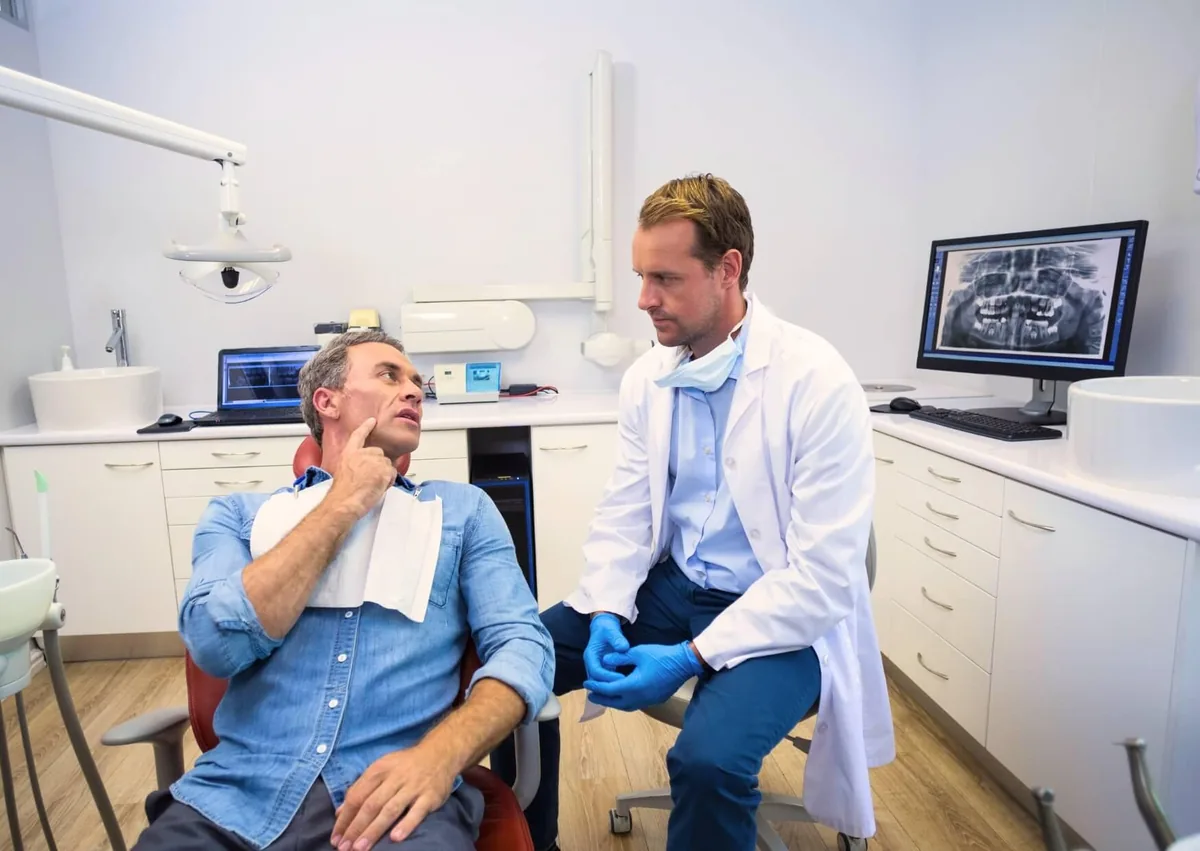
Planning begins with a review of goals, health conditions, medications, nicotine use, prior dental treatment, and daily hygiene ability. This is part of implant treatment planning.
The exam usually looks at the gums, remaining teeth, bite, smile, denture fit, bone volume, and the space needed for a durable restoration. Records may include photos, digital impressions, X-rays, and CBCT imaging.
For full-mouth treatment, the restorative dentist and surgical clinician may coordinate implant positions, temporary teeth, and the final prosthesis before surgery starts. That planning is especially important when the goal is a fixed full-arch result.
During surgery, the area is numbed and sedation may be available when appropriate. The clinician prepares the bone, places the implant, and may also perform extraction or grafting during the same visit if the case allows.
The implant may be covered during healing or fitted with a healing component above the gums. In some cases, a temporary crown or bridge is placed early, but it is designed to protect healing rather than handle full chewing forces.
Needing grafting does not mean it is too late. It usually means treatment needs another step to rebuild support before or during implant placement.
Patients with severe bone loss, unstable dentures, or failing teeth may still qualify for full-arch treatment with angled implants, staged grafting, or a removable implant-supported design. The decision depends on anatomy, bite forces, medical risk, and long-term maintenance needs.
This is one reason a comprehensive evaluation matters more than assumptions based on how long teeth have been missing. A complex case may still have a practical path forward.
Swelling, tenderness, bruising, and minor bleeding are common during the first few days after surgery. Patients should follow their own post-op instructions rather than relying on a generic timeline. See how to prepare for dental implants.
Osseointegration, the process in which bone bonds to the implant surface, often takes several months. Grafting, sinus treatment, implant stability, and medical factors can shorten or extend the timeline.
|
Stage |
Typical Purpose |
Approximate Timing |
|---|---|---|
|
Evaluation and digital planning |
Confirm candidacy and design treatment |
One or more visits |
|
Grafting, if needed |
Rebuild implant-supporting bone |
May heal for several months |
|
Implant placement |
Position the implant in the jaw |
One surgical visit per planned phase |
|
Osseointegration |
Allow bone to stabilize the implant |
Commonly several months |
|
Final restoration |
Attach the crown, bridge, or arch |
After healing and restorative checks |
Immediate temporary teeth can reduce time without a visible restoration, but they do not eliminate biological healing. Full-arch cases may also need several adjustments before the final teeth are delivered.
Contact the treating dental team promptly if pain or swelling worsens after first improving, bleeding continues, fever develops, pus appears, the wound opens, or the implant or restoration feels loose. A bad taste that persists can also be a sign of infection.
Difficulty breathing or uncontrolled bleeding warrants emergency care. New or persistent numbness, altered sensation, trouble swallowing, or severe symptoms should not wait for a routine follow-up.
Implants do not get cavities, but the surrounding gums and bone can still become inflamed or infected. Peri-implantitis can lead to bone loss and implant failure if plaque control and maintenance are poor.
Daily cleaning needs to reach around the implant and under bridges using tools matched to the restoration. Regular exams help monitor gum health, bone levels, bite forces, component wear, and restoration stability.
Clenching or grinding can overload implants and damage prosthetic teeth or screws. A protective appliance may be recommended, and avoiding nicotine while keeping chronic conditions controlled can improve long-term predictability.
A good candidate usually has treatable oral disease, enough bone or a workable plan to create support, and health that allows surgery and healing. The patient also needs to be able to clean the restoration and commit to long-term maintenance.
People with major bone loss, unstable dentures, failing teeth, or prior implant complications may benefit from evaluation by a dentist with advanced implant and restorative experience. Learn more about complex dental cases.
A prosthodontist specializes in restoring and replacing teeth, while an oral and maxillofacial surgeon or periodontist may help manage surgical or bone-related complexity. The next step is a comprehensive consultation with clinical exam and three-dimensional imaging, not assuming too much time has passed.
A focused implant consultation can confirm candidacy, explain grafting or full-arch options, and outline a clear treatment timeline. Contact Scottsdale Center for Implant Dentistry for dental implants in Scottsdale, AZ, serving North Scottsdale and Carefree; call (480) 306-8510 to schedule an appointment.
Possibly. Long-term denture use often reduces jawbone volume, but CBCT imaging may still show enough bone, and grafting or a strategically planned full-arch approach may expand the options.
Severe bone loss can limit standard implant placement, but it does not always make treatment impossible. The answer depends on the location of remaining bone, nearby nerves and sinuses, medical risk, grafting feasibility, and the type of restoration being considered.
No, not by itself. General health, oral condition, healing capacity, hygiene, and treatment goals matter more than chronological age.
An implant may be placed at extraction, after early soft-tissue healing, or after the site has healed more fully. Because bone changes after tooth removal, early planning can preserve more options even when surgery will happen later.
A second evaluation may be reasonable because imaging, grafting methods, restorative designs, and health status can change. It may confirm the original concern or identify another option, but no technology can guarantee candidacy or success.